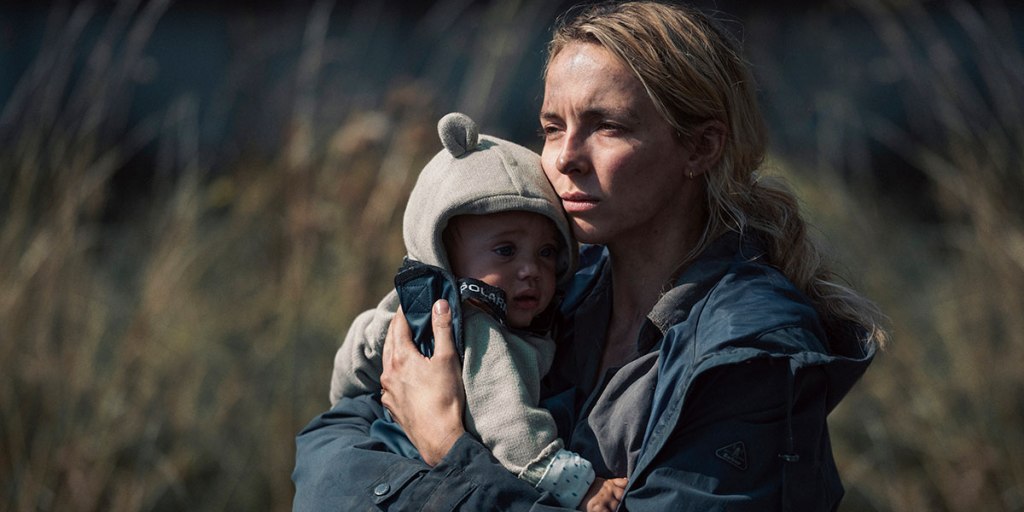
Jodie Comer’s career has been on an up trajectory ever since the premiere of Killing Eve. It has showcased all of her skills and proved to everyone that she is one of the finest working actresses of her generation. And The End We Start From is exactly that showcase once again. Directed by Mahalia Belo in her feature directorial debut, The End We Start From explores a mother’s love for their child and how far they would go to ensure they get the life they deserve.
When a natural disaster floods the streets of London, a new mother (Jodie Comer) and her partner (Joel Fry) are forced to leave their life behind and find a way to survive in this new world and their newborn child.
Jodie Comer has proven time and time again that she can do pretty much anything. Her screen presence is extraordinary, and Belo’s camera loves to linger on her as she continues her impressive run of exceptional performance. Comer’s nuanced and quiet performance brings the film into a more elevated field than without her. She is in almost every scene, commanding the screen and elevating every word from the script. Comer’s performance brings air to everything in the film.
The natural disaster that occurs in the film acts more like a background character, with instead having the focus centred on humans and their reaction to such events. It is much less of a disaster film and more about survival, about how far one would go for them and their loved ones. At its core, the film is never interested in becoming a commentary about our planet and environmental crisis; instead, it focuses on humans and their reaction to it.
The film’s slow pace is sometimes an issue, mainly when, towards the middle of the film, it introduces these visions\flashbacks that stop everything in its tracks. It is clear the use of it is made to showcase the emotional state of the characters, but while it would have worked if it had been used from the start, the fact that it is not introduced until well into the film makes it clunky and never truly works it is intended too.
The direction from Belo showcases her talent and the bright future she has in front of her. The way she frames, Comer slowly reveals more and more. There are moments when she keeps the camera on her a little longer than you usually would, but she understands the actress she is working with, which elevates it all. The direction is tender when it needs to be, rushed and stressed when it deserves it. Belo understands her subject, and she optimizes it to the best of her abilities.
The End We Start From shines with the different approaches to approaching the disaster at the film’s center. It never tries to focus on it, instead choosing to frame it more as an afterthought. The humans and their reaction to it make this film work, primarily when you center it all around Comer’s performance. It might not be perfect, and in many ways, the second act suffers a lot when it comes to the languid pacing, but it can be forgiven because of how it tells its story.
 The UnderSCENE